2021-06-20 · 1분
BOJ 11047 — Coin 0
A short write-up for BOJ 11047 (Coin 0), a greedy coin problem.
algorithmboj
2021-06-03 · 2분
This post is over 2 years old. The content may be outdated.
BOJ #1158 problem: https://www.acmicpc.net/problem/1158
We'll solve the problem using the queue learned in [Algorithm] - Queue!
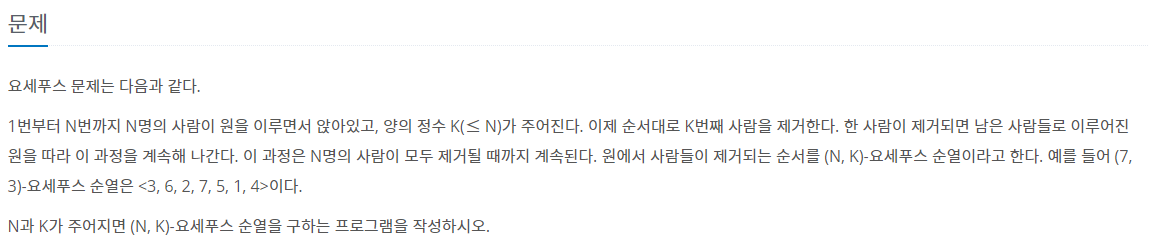
In computer science and mathematics, the Josephus problem (or Josephus permutation) is defined as follows.
Assume n and k are natural numbers and k < n. When n people are gathered in a circle, you count the order starting from an arbitrary person and remove the k-th person from the group. From the remaining n-1 people, you again count the order from the next person and remove the k-th person. You keep repeating this until no one is left. The order in which people are removed from the group is called the (n, k) Josephus permutation, and the problem of finding the last person removed is called the Josephus problem.
I used the queue supported by the C++ STL.
For (7, 3):
Push then pop up to N-1 times,
and for the Nth, repeating front then pop should solve it.
See more
#include <cstdio>
#include <cstring>
#include <queue>

using namespace std;

int main() {
    int N, K;
    queue<int> Queue;

    scanf("%d%d", &N, &K);
    fgetc(stdin);

    for (int i = 1; i <= N; i++)
    {
        Queue.push(i);
    }
    printf("<");
    for (int i = 0; i < N - 1; i++)
    {
        for (int j = 0; j < K - 1; j++)
        {
            Queue.push(Queue.front());
            Queue.pop();
        }

        printf("%d", Queue.front()); printf(", ");
        Queue.pop();
    }
    printf("%d", Queue.front());
    printf(">\n");
    return 0;
}
Original (Korean): tistory — published 2021-06-03, migrated to this blog. This translation was generated with the help of AI.
…